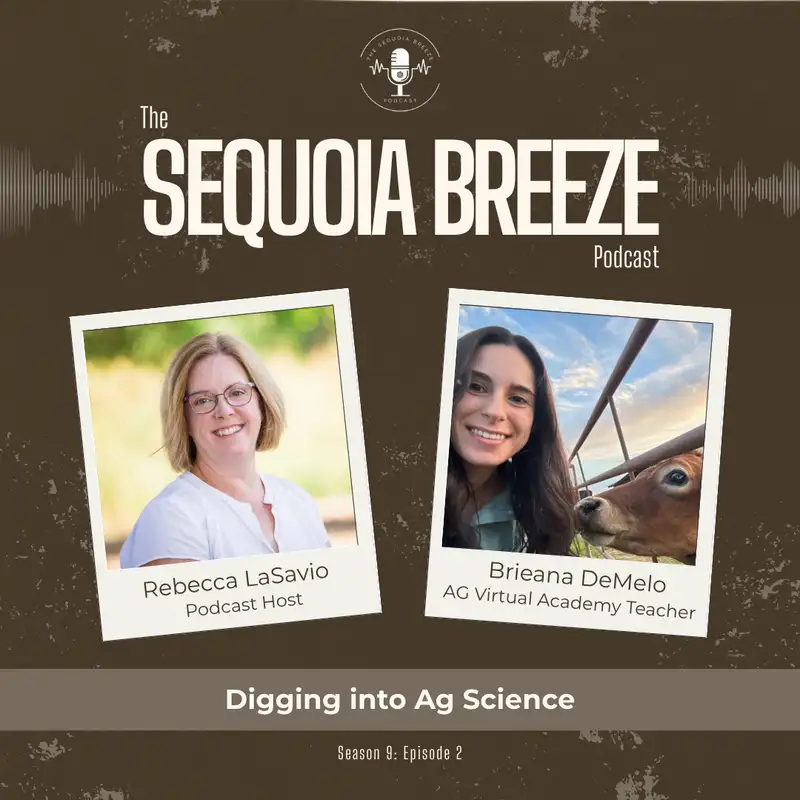
Rebecca: Hello and welcome to the Sequoia Breeze Podcast, a breath of fresh air for your homeschool.
I am your host, Rebecca La Savio.
Thank you for joining me today.
Welcome, listeners.
I can't wait to introduce you today to Brianna DeMello, who is in her second year with us at Sequoia Grove as our resident ag teacher. And I'm sure that's not her proper title, so I'm going to let her introduce herself and explain it, but welcome, Brieana.
Brieana: Hello. I'm so happy to be here.
Yeah, so my name is Brianna DeMello. This is my second year with Sequoia Grove and I'm part of the Virtual Academies. So this year I'll actually have classes in both the high school Virtual Academy and, and then the junior high Virtual Academy, which I'm really excited to be starting this year.
Rebecca: So, Brianna, tell us a little bit about how you got into. You're an ag teacher. How did you get to that role?
Brieana: Yeah, so I always kind of wanted to be a teacher. Ever since I was little, a lot of the really important people in my life were teachers. Both of my aunts,
one of my uncles is also a teacher.
I was one of those kids that when I was a kid, I was always playing teacher with my cousins and my sister and making them do homework and all of that fun stuff that I'm sure they didn't love, but I did.
So I kind of always grew up wanting to be a teacher. But then when I was in high school,
I started taking ag education classes at my high schools as part of the FFA program at Gault High School, where I went to school.
And when I was there, I just became really invested in the program. And prior to that I had experience. My family has had a dairy,
so I grew up with agriculture. I always wanted to be a teacher. And then when I was in high school, I was in the ag program. And that kind of introduced me to this world of,
wow, you can marry those two things, you can have ag and education all at the same time in one career. And so my ag teachers were also really important people in my life and they kind of helped me understand,
you know, how to apply for college and do all of those things. Because neither of my parents finished college. And so they were like, yeah, maybe you should pursue a career in ag education.
And I was like, you know what,
you're right, I should. I'm really happy when I do that. I love taking people to the dairy and giving them the little tour and all those things. So I decided that that's what I wanted to do.
And so from there I went to Cal Poly San Luis Obispo,
and I My major for my bachelor's degree was agricultural science, which is kind of a broader degree that covers everything from animal science, plant science, a little bit of,
like, irrigation and a little bit of everything, but my emphasis area was in animal science.
And then after that, I stayed for an additional year and chose to get a master's degree in ag education.
And then from there I started teaching.
Rebecca: And is this your first job?
Brieana: No, I taught at a brick and mortar school in.
It was Lodi Unified, but it was a school in Stockton. So it was a really cool place to work because it was right on the border of, like. My students were not very rural, but we were kind of also very close to a rural setting.
So it was really cool to, for a lot of kids, be their first experience with agriculture.
Rebecca: How did you find Sequoia Grove?
Brieana: I found Sequoia Grove kind of by a happy accident. I was just looking on ed join at different positions, and I had never heard of a virtual school that offered ag education classes.
I kind of thought it was made up at first. It sounded too good to be true. I was like, wow, this is really cool. I've never heard of such a thing.
And so I, you know, clicked on the button, read through it, and then I was like, wow, this is awesome. So I ended up deciding to apply,
and I have been really happy with that decision. I've absolutely loved my time here, and it's been really cool to, over the past year, kind of figure out how to adapt what I've learned through brick and mortar ag education and figure out how I can adapt that to this type of school setting and our student body and to meet their needs.
Rebecca: You were raised on a dairy, so obviously you know something about cows. You were in ffa. What kind of projects did you do there?
Brieana: I was really involved in all parts of ffa, so in the kind of traditional sense, when people think of ffa, a lot of the time they think of, like, the county fair and stuff like that.
So I did participate in that. I showed market rabbit and a breeding rabbit for a little bit, and then I did market goats, and a couple of years I showed a dairy heifer also.
Outside of that, though, I also was involved in a lot of the other areas.
So I did a couple of career development events in ffa, which are these contests that are hosted by different colleges throughout the state with the goal of developing students who are career ready.
So I did the let's see, what was it called? Cooperative marketing contest my sophomore year. We actually won the state that year, which was really cool.
And then I did the poultry evaluation contest, which was my personal favorite one.
We were second in the state with that one. And that one is really awesome because it basically prepares you for a career, is like kind of,
I guess someone like in the usda, like food quality control, that type of career, which was really awesome. So those were a ton of fun. And then I also did some leadership development events, which is more like the public speaking kind of area of FFA and ag education.
I did,
I did the FFA creed my freshman year. And then my favorite one, which I wasn't very good at, but it was still a really great learning experience, was parliamentary procedure.
So learning all about Robert's Rules of Order and then like doing mock debates on ag topics and things like that.
Definitely had a learning curve, but it was a lot of fun to. To learn about.
And then beyond that, you know, I did like the leadership conferences too, all throughout all four years. The state conference, the national convention,
all of those sorts of things.
And yeah, I'm sure other things too, that I can't think of right now.
Rebecca: But what I'm hearing from you is that an ag education is not simply learning to raise a pig.
Brieana: No,
I'm that too. It's that too. But there's so much more. You know, I tell people all the time, like,
what do you think of when you think of the word agriculture? And almost always,
understandably, but almost always it's a farmer, which,
you know, valid. But agriculture is so much more than just farming. And I try to get that kind of mindset ingrained in my students too, because there's careers.
You can make any career, an ag career, in my eyes. You know, you. You want to be a lawyer? Okay, cool. Need lawyers in agriculture. You want to. You want to do engineering.
Awesome. We need engineers, too. Like any career that you can think of,
I mean, that I can think of,
you can find a way to relate back to agriculture. So I think something that's really important for students to understand is that even if you don't see yourself in the future in a career related to agriculture, there's still a lot that you can get out of an agriculture class.
We,
we are doing activities and games and going through these experiences that give students these transferable skills, no matter what career you choose to end up in,
although hopefully it's an ag one.
Rebecca: And while kids are raising an animal, they think their point is to raise the Animal. But the adults actually know.
Brieana: Oh, it's so much more than that. It's responsibility, it's communication. It's all of these different Learning to
Rebecca: have a good attitude when it's hard and you're tired and it's 6am and you don't want to do this thing
Brieana: anymore and it gets sick. Sick and. Yeah.
Rebecca: And it got loose.
Brieana: A pig in the pool, you know,
Rebecca: and the sheep that won't cooperate with you or. Yeah.
In the short amount of time that you've been here, you've already built so much that you,
I. It's already made me wonder what you will have accomplished in another five years because you did so much so quickly. So you obviously have ideas and drive and enthusiasm.
So talk to us a little bit about what exists now at Sequoia Grove for our kids because you actually hitting a pretty wide age band.
Brieana: Yeah.
So we've,
I've kind of played around a little bit with what agriculture looks like at Sequoia Grove just to kind of figure out how to best meet student needs and navigate what it looks like in a school like ours.
And so kind of what we've settled on is agriculture at Sequoia Grove is kind of broken up into these two different areas we'll call them. The first one is the Ag Club and then the second one is the Ag classes.
So I'll kind of start by focusing maybe on the club and talking about what that offers for students. So the club this year is actually going to be grades five through 12.
So it's open to a pretty large group of students at Sequoia Grove. It's totally free,
which we love. And it's every Wednesday at 3pm and it's fully virtual. There are some in person opportunities, but the actual club meetings themselves are fully virtual. So anybody can participate in that.
We have a Google classroom for that. So students can join that to get updates on like what we're talking about every week at our weekly meeting and kind of just stay up to date.
But the Ag Club is really just based on student interests. We're not necessarily hitting on any like learning standards per se. I have a lot of flexibility there to, you know, if a kid says I really love chickens, I want to learn more about chickens, I can say, okay,
cool, come back next week.
So I have a lot of flexibility with that. And it's not just agriculture in Ag Club. It's kind of a mix of both agriculture and leadership. So there's a little bit of both that happens there.
But in terms of like what are we doing in ad club?
All sorts of things. We've had guest speakers, so, yeah, guest speakers. We've had Ag club. Students are also invited to any of the agriculture field trips that I host. So students can go in person to, you know, different farms or different agricultural colleges to learn more about what they offer and things like that.
And then,
you know, we've done butter bingo. We've done, like a hunger banquet to learn about the effects of hunger on different populations.
We've done.
Let me think.
Rebecca: Do kids ever come with problems they're having with their animals and just ask for advice? Or is that maybe beyond the scope of.
Brieana: Well, I'm not a vet, so I can't.
I can't give you any prescriptive advice. But, yeah, it's definitely something that we've talked about before, if kids have questions about those sorts of things. And, you know, sometimes, oftentimes, you know, we all kind of have our niches.
So, like, I have a particular love for dairy cattle, but maybe I. I don't know a ton about pigs, but we have another student who has raised pigs her whole life, and she's like, oh, I can answer that.
You know, so it's kind of a nice place for students to be able to talk about their experiences and things like that too, for sure.
Rebecca: Collaborative.
Brieana: Yes.
Rebecca: Yeah. So that's for 5th through 12th grade, Wednesdays at 3. There's no signups. It's. They're just available to participate. Where do they find the link for that?
Brieana: Yes, good question. So the link for that is on the Sequoia Grove website. If you type in, like, clubs. On the clubs.
Rebecca: On the bridge.
Brieana: Yes, on the bridge. If you type in clubs, it'll. It'll pop up as one of the
Rebecca: clubs, and it's just called the Ag Club.
Brieana: I think the official name is the Sequoia Grove Agriculture Club.
Rebecca: Okay.
I will put the correct name in the show notes and I think a link to the bridge, but obviously you have to be able to sign in to get to it.
Okay, so then that's the club side of things. And then I just also want to put a shout out that Brianna was very thoughtful in her with her club. She sent a little acknowledgement to her graduates, and she takes.
She sees those kids personally. So she isn't just talking about animals. She's most definitely looking at the kids and what they need.
So talk about your classes. So you said virtual academy for both
Brieana: junior high and high school,
and that's new this year. Last year was just high school. So this year we're adding on a JHBA class, which I'm super stoked about.
So within the classes, again, we can divide that up into two pathways.
And so the goal for students, it's not required,
but my goal for students would be to become what we call a pathway completer in career technical education.
So we would want them to complete a full pathway. The first pathway that we offer is called agriscience, the agriscience pathway.
And the introductory class in that pathway is called Intro to Ag.
And that class is open to students grade 7 through 10. So that's the JHBA class that I had kind of mentioned.
That Intro to Ag class is what it sounds like. It's a super hands on, engaging, a lot of like game based learning type stuff happening in that class. But the way that it's divided is I've pretty much got one unit on these different sectors of agriculture.
So we'll do like a short one month unit on animal science and then plant science and then ag business and then like the ag mechanics sector and all of these, you know, ag leadership, all these different areas of agriculture.
And the goal is for students to be able to identify what sectors of agriculture align most with what they're interested
Rebecca: in, you know, sectors they probably didn't know existed, some of them before they even started the class.
Brieana: Yes. Yeah. And so to hit on that point further, we also,
I have a ton of guest speakers in my classes. I had one student in particular.
We had,
we did like a short lesson on soil science one day in ag biology and he was just so enthralled, the same way that I was when I first learned about soil science, because he had no idea that.
So he was like, did you know you can study soil science in college? And I was like, yeah,
you can. It's crazy, right? And he had no idea. And I actually also didn't learn that until I was in college and I was equally excited by that. And so he ended up, you know, I had a guest speaker come into my class later that year who was a soil scientist for the state.
And so he got to like connect with him and network with him and ask him questions about his job and what it took to get there and all that kind of stuff.
And then he ended up buying a book about soil science on his own because he thought it was so cool. So I'm proud of that. But yeah, so they're learning about all of these different careers in agriculture that they've probably never heard of.
You know, we hear of the farmer we hear of, the vet, we hear of some of these more common ones. But there's also a million jobs out there that they don't know about that we're trying to expose them to as we go through each of these different sectors.
And you know there's going to be some that they don't love. You know, personally I'm not a big ag mechanics person. I did it, I tried it. Not my favorite.
But there's also going to be the ones that they haven't heard of like soil science that they end up falling in love with. So that's the goal with that class and that's the introductory class for the agri science pathway.
After that a student their freshman or sophomore year would take ag biology. So ag biology is a cool class because it's aligned with both the NGSS or next generation science standards and also with the agriculture, food and natural resources standards for the state.
So we're,
it's fast paced class because we're learning about a lot of different things.
But it's really nice because both our ag bio and ag chemistry classes are you know,
in the eyes of the state, it's the same as taking a regular biology or regular chemistry.
Rebecca: That was going to be my question is it's, it can be in place of a standard biology class.
Brieana: Yeah, you're meeting the same requirements, we're hitting the same NGSS standards. The only difference is that we're going to hit all of those standards and contextualize them within agriculture.
So for example, in this ag biology class, you know, in biology you learn about body systems,
one of which would be the digestive system.
In ag we're going to learn about the digestive system but we're also going to learn, you know,
the non ruminant digestive system, the ruminant digestive system,
the digestive system of avians, like all of these different,
I don't know what the
Rebecca: word I for non aggie people. We're talking about like sheep and cow system systems versus are pigs ruminants? I don't even know no pig.
Brieana: Pigs are non ruminants or monocults.
Yeah, so pigs are simple stomached similar to humans.
Ruminant would be a four chambered stomach. So like a cow is the most common example of that.
And then avian would be like chickens.
But yeah, so like we'll learn about the digestive system but as it relates to agriculture and then you know, diseases of the digestive system,
particularly ones that affect livestock, things like that.
But yeah, so same standards Just contextualized within the industry of agriculture.
Rebecca: I want to take your classes.
Brieana: They're so fun.
Rebecca: I didn't know I was interested in all of this stuff till much later in life,
nor was this offered when I was in high school.
Okay, so you have currently two HSVA classes. Wait,
so Intro to Ag is available for JHVA or HSVA or high school?
Brieana: Yes, because it's grade seven through 10.
Rebecca: Okay. Yeah, so it's the same class. Okay. And then after that then they can take the Agricultural Biology. Yes, but you also said something about agricultural chemistry.
Brieana: Yes. So Ag Chemistry is what we call the capstone class in that pathway. It's the last class in that series of three for agroscience. So that intro to ag is the first one.
AgBio is the middle one. And then Ag Chemistry is the last one.
Ag Chemistry is similar to agbio in that it's again NGSS and Ag, Food and Natural Resource Standard aligned. So it'll take the place of your regular chemistry class.
And then it's just again contextualized within agriculture. So you know, instead of just talking about chemical reactions, we'll talk specifically about chemical reactions that are happening in ag and that impact the industry.
Rebecca: So are the other two classes a prerequisite for that chemistry class?
Brieana: Intro to Agriculture does not have any prerequisites.
Ag Biology does also does not have any prerequisites.
And then Ag Chemistry, the prerequisite for that is Ag Biology and Then also algebra 1.
Just because you know.
Rebecca: Which is standard for chemistry too. Yeah,
for chemistry also.
So is Intro to Ag for a seventh or eighth grader, Is that an elective or is that a replacement for a science class?
Brieana: That one would be an elective.
Rebecca: Okay. It's not a science the way the biology and chemistry are.
Brieana: I don't believe so.
Rebecca: Okay. That's not all you do though, right?
Brieana: No, that's just one pathway. We have a whole other pathway too.
The other pathway though,
we. We kind of double dip. So the again, it's the series of three classes for our animal science pathway.
The first class is that same Intro to Ag class.
The middle class is that same Ag Biology class. The only difference is the capstone that third class.
So for a student to become a pathway completer in the area of animal science,
they take Intro to Ag, Ag Bio and then our animal science class.
Rebecca: Okay, and is the animal science class the dual enrollment class?
Brieana: Good question. Because that's also a little bit tricky. No.
Okay, the animal science class is actually gonna be new next year will be our first year offering it fall of 27, correct? Yes.
So fall of 27 will be our first year offering that. We do also have a dual enrollment animal science class through Yuba College, but that is not part of a pathway.
That's just like an additional. You really like animal science and you wanna get some college credit and you
Rebecca: teach that one as well? Yes. Okay, talk to us about the advantage. Why would a student want to finish a pathway? What does that bring them?
Brieana: The reason that a student should want to finish a pathway is a. You get recognized for it. So at the end of the year in Ag Club, we do like a little banquet, and we recognize all of our pathway completers.
But also because the school keeps track of how many people become CTE pathway completers.
The other thing, too is with career technical education, the goal is for students to become college and career ready. So, like, that's something you can put on a resume. You've taken a series of three classes to become a pathway completer in the area of agri science or animal science or whatever it may be.
Rebecca: Okay.
Obviously, we're across, I believe, 14 counties,
some more rural than others.
We have a lot of students that do live very rurally, and then we've got a whole lot of students that live in the middle of Rockland.
So does a student need to be in a particular location to be interested in these things?
Brieana: No. There's kind of a growing trend in urban agriculture within the industry as a whole, as we try to produce more food on less land. So there's definitely kind of some growth in that area.
But then also,
you know, less than 2% of people are directly working in agriculture,
and the average age of the farmer is like 58 or something like that, according to the USDA.
Rebecca: It's really.
Brieana: So there's a big disconnect between consumers and the people growing our food. But all of us eat three times
Rebecca: a day, so we're homeschoolers. We have second breakfast.
Brieana: Yeah,
yeah.
So,
you know,
we all have this connection to agriculture, whether or not, you know, like I said, it's not just farming. We all have this connection because we all need to eat. And it's really important that we know where our food comes from, how our food is grown, because your voice matters.
You know, you should have a say in that and be an informed consumer. So I think any student has something to learn from an agriculture class, regardless of where they live, if it's a career they see themselves in or not,
Rebecca: so they can be successful in the CTE pathway,
even if they're not raising any animals, they don't have a garden going. They've got plenty to learn.
They don't necessarily have to be doing
Brieana: any of those things a hundred percent. You don't have to have any agricultural background to be part of the club or the classes. Everything that you need to learn, you'll learn there.
Rebecca: Talk to us about where you see this program going because again,
you've only been here for a year and a bit and you've, you're teaching, I think I counted seven classes plus running the club.
So you've obviously built this program a lot in a year. So I'm sure that you have some dreams about what you would like to see happen in the future.
Brieana: I have a lot of dreams, yeah. So this year, something that I'm hoping to start and we'll see if it, if it happens or not, but something I'd like to start doing is some in person lab days.
So in our ag classes we do virtual labs. We do like scenario based questions and activities and things like that.
And there is some hands on component even in our virtual classes that students can do at home.
But we're currently, as it stands, we don't have like an in person lab day where I could do all the labs that I would do in a brick and mortar school with all of our students.
So I would really love to add an in person lab day in the future.
And then another area that I really want to work on is some scholarship opportunities for our students within the world of agriculture. There are tons and tons of scholarships outside of Sequoia Grove.
But I would love to eventually be able to offer a scholarship for our graduating students who have demonstrated involvement in the program during their time with us. And then the agricultural world is an
Rebecca: enthusiastic place like they,
especially with young people, they want to encourage and support and help and motivate and there's, there's a lot out there to come around students that are really interested.
Brieana: Yeah, no, there, there is that. The agricultural community is so supportive of youth who are interested in learning more regardless of if they pursue it as a career or not. They're just happy to be able to share what they do with people.
So yeah,
currently as it stands, we have an agriculture website on the bridge and as part of that website there's a little button you can click that has it like links to a list of some agricultural scholarships that students could potentially qualify for depending on the program that's offering the scholarship.
But like I said, I'd really love to be able to reach a place where we can have like a scholarship specifically through Sequoia Grove. And then I think the last area that I haven't actually said out loud before is I took a class this summer for some professional development that was about preparing students for the workforce.
And I know that there's some other schools that are doing like work based learning and apprenticeships type of situation and I don't see that happening for us in the near future, but looking like long term, that's something that I would be interested in kind of learning more about and seeing if that's something that we could implement for our students.
Rebecca: Is there anything else you want parents to know about you or about the programs?
Brieana: I think just to feel free to reach out. I do a monthly newsletter for the agriculture program. So if you're interested on interested in being added to that newsletter, feel free to send me an email and I can add your email onto the list or if you have questions, feel free to email me.
I'm also very responsive to feedback. So if there's anything that I'm not doing that you're like,
I would really love it if our school offered this or did this. I can't promise you that I can do it, but I can try. So feel free to send that my way and I'm happy to help however I can.
Rebecca: Do you have any.
I know you've got. So you've got some great stuff going for fifth grade and up.
And there's always a group of enthusiastic younger kiddos that would love to talk about animals, learn more about animals. Do you have any resources or suggestions for those parents?
Brieana: Yeah, so there are lots of curriculum resources that you can find online. I don't have anything like on my, on the ag website.
I can maybe I could add that like a list of some curriculum resources for some of our littles. But there's lots of great resources through like 4H FFA. If your kids are a little bit older, there's some resources on the FFA website.
Rebecca: 4H has a lot and they're not expensive and they are a vendor. So you can, if your kiddo wants to learn all about chickens, you can get books just about chickens.
And they're not like year long curriculum but they're definitely a good introduction to.
Brieana: Yes. The other two big ones outside of the 4H curriculum is the National Agriculture in the classroom they have like a curriculum matrix which is really cool. They have a lot of game based learning stuff which I think is very fun and it's a lot of.
It's geared towards some of the like K through 5 grade band. So that would be a good place to look. And then also the California foundation for Ag in the Classroom is a phenomenal resource.
They have tons of, I think they even have like coloring pages. They've got like little one page commodity fact sheets that are really great. They have all sorts of fabulous resources.
And then what our program does offer for the Littles is in the fall every year our Ag club students host an elementary Ag day.
So our club members basically work really hard to plan a little event and they share a little bit about what their knowledge in agriculture is like, their expertise. So they get to share, you know, about gardening or your daughter shared about rabbits.
And then we also read, we do like a little story time on with an agricultural book and we end with a little coloring page for the kids. Very cool.
Rebecca: I will do my best to get all of these resources as on in the show notes.
So and links, links to announcements and things and Brianna's email because her name isn't spelled super clearly.
Brieana: It's Brie like the cheese. Ironically grew up on a dairy. Is Bri like the cheese?
Rebecca: That's a great way to say it. Brianna DeMello. And so just to clarify the are all of the different classes available at the same time?
Brieana: Good question.
So because right now I'm the only ag teacher,
we're not offering all of them all the time.
So it's on a two year rotating schedule.
Year one,
so school years that begin in even numbers. So like this year 20, 26, 27, 28, 29 and so on.
We offer the Intro to Ag, Ag Biology,
Ag Chemistry and then the dual enrollment Animal Science class with Yuba College in the fall.
Year two,
we offer the Intro to Ag, AgBio, Ag Chem, and then the high school, the HSVA animal science class.
Rebecca: Okay, so the dual enrollment one will be every other year.
Brieana: Correct.
Rebecca: Okay.
Well, thank you Brianna for coming and talking to us today. It's been really exciting to learn more about this program and where it's going and all of the really cool things that you're doing.
So thanks for investing in our kiddos.
Brieana: Thanks. And thank you so much for having me. It's been so fun.
Rebecca: I hope you enjoyed this episode of the Sequoia Breeze podcast. I hope it's been a breath of fresh air for your homeschool. I've been your host, Rebecca LaSavio. If you know somebody else who might enjoy learning more about the ag program and at Sequoia Grove, please pass this episode along.
Sharing liking subscribing and leaving us a review really goes a long way to help the podcast.
Thank you for being here and have a wonderful day.