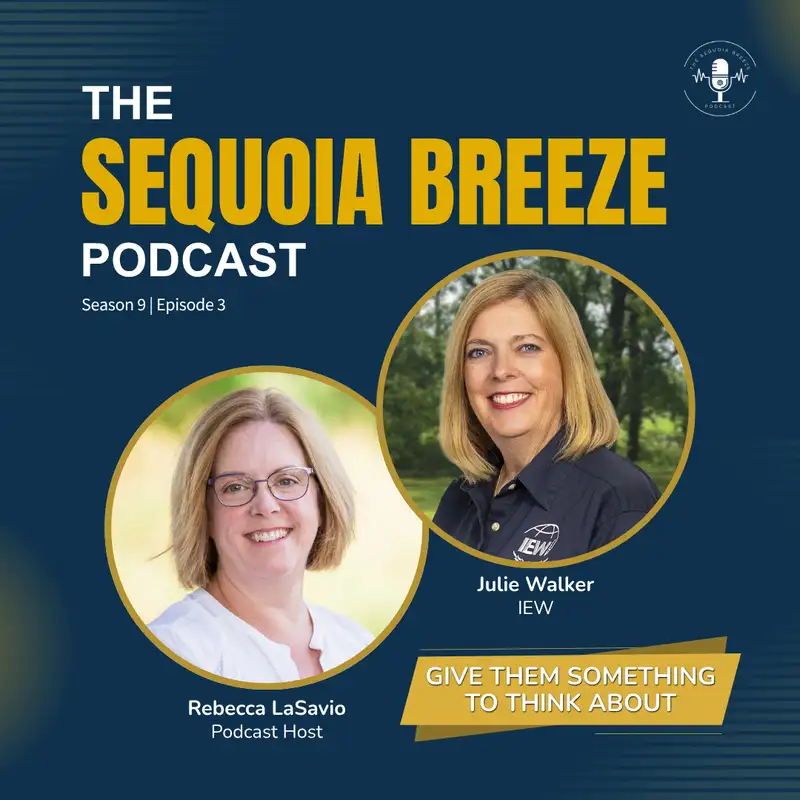
Rebecca: Hello and welcome to the Sequoia Breeze Podcast, a breath of fresh air for your homeschool.
I am your host, Rebecca La Savio.
Thank you for joining me today,
Listeners. I am honored today to have Julie Walker as a guest here.
And Julie serves as the Chief Marketing Officer at the Institute for Excellence in Writing, or you might know it as iew.
She has played a key role there in producing, directing and co writing many of the organization's instructional materials, including Structure and Style for students, video courses.
She also co hosts the popular Arts of Language podcast alongside Andrew Poudois. And after earning her MBA from Biola University, Julie relocated with IW from here in California to Oklahoma.
Before the move, she spent several years teaching primary grades and homeschooling her own three sons just three miles away from Disneyland. Julie, welcome.
Julie: Thank you, Rebecca. It's an honor and privilege to be here.
And I just love that your families are in Northern California because although I didn't leave my heart in San Francisco, I was just there very recently cheering my son on, who was in a pizza competition in San Francisco.
They did a, they do a pizza festival every year.
So that was really a delight. And then my,
my son and his wife and their two kids live in Mendocino county, which I know you have many families from that area,
so definitely love Northern California, love the weather, love the,
all the opportunities you have to just get out in the, in the fresh air and see so much beauty.
Rebecca: And I love that the last few years I've gotten to see you every year at the Northern California Homeschool convention. So that's always a treat.
And this year's talk that you gave there gave birth to the idea for this particular episode. So I'm excited to talk to you about today's topic. But I think a lot of parents, I'm going to say don't turn us off yet.
Julie: Give it a chance. Right?
Rebecca: We are going to talk about memorizing to think.
There's a little bit to unpack in that title. First of all,
what does it mean to think?
What is the goal?
Julie: Well,
of course we want to raise our children to be thinking, contributing members of society.
And I think this generation in particular is in danger of outsourcing that to large language models, ChatGPT,
that sort of thing where we can use shortcuts to maybe get our work done faster,
maybe be able to write that little essay.
And ultimately, what we're doing is robbing ourselves and our students the opportunity to wrestle with ideas,
to have conversations either with another thinking adult or even with themselves. Is the this true?
And if it's not, then what is actually true? And how can I find that out?
And why is this such an important skill to teach today?
More so.
More so than ever before, Rebecca. So this whole talk, memorizing to think,
kind of starts with the idea something that Louis Lamour,
he was, in case you don't know who that is, he was a. A writer of westerns. And he talks about that.
A brain, a writer's brain is like, I'm kind of paraphrasing here, is like a.
A magician's hat.
You can't get something out of it until you put something in there to begin with. So you know that. Watch me pull a rabbit out of my hat. Well,
before the show, the magician put something in the hat that he's now pulling out. And so what we are wanting to do is put things in that hat so that they have the words,
the language, the ideas to think from,
to think with.
And that the easiest way, the best way to get that content into your student's hat,
brain,
mind, whatever we call that organ that provides thinking. See, I'm at a loss for words is by memorizing.
Rebecca: It's sort of fascinating to me that thinking, which is so essential to just existing, is actually work.
And it, it's a learned skill.
And so our kids resist it. Sometimes we resist it. We don't want to think either. Right.
Julie: Yeah.
I think about what I would say to my own boys.
And Rebecca shared with you that I homeschooled.
I have three boys, and we,
we lived in Garden Grove, right on the border of Anaheim, literally three miles from Disneyland. And I tell people that's why I homeschooled, because I didn't want to wait in line at Disneyland.
We could go on the days where there wasn't a lot of people, which nowadays is gonna say, I think you're
Rebecca: in line no matter what.
Julie: Now,
no matter what, you're always in line at Disneyland.
But in, in raising my boys, I, I, that I. One of the things that I used to say to them is hard work is immensely satisfying.
And that idea of, don't,
you know, I used to. I also used to say to my boys,
you are being raised. They're millennials, and so they're in their late 30s and early 40s now.
But I said, I am raising you amongst a peer group that may not know how to work hard,
that may know. Not know how to see what needs to be done and do it, may not know how to be leaders.
And I know this is hard for you right now, but you'll thank me later.
And they will. And they did, and they will. And I think even, even more so today,
that skill of thinking.
And you know, we're just going kind of old school here, here with the idea of memorizing.
And you know, Rebecca, you mentioned the talk that I gave in the Northern California homeschool. Com conference. And I'll be doing that again actually in conference in the next school year, next summer in Missouri.
I think I'm going to Missouri or Kansas, somewhere up there. And it's the same, it's the same talk. And, and I lead with that, this idea of why schools are no longer valuing the skill of memorization.
And there's three reasons. And if you don't mind, I'll just hit those reasons. And maybe some of your listeners have this. Why should I make my children memorize anything?
Everything that they need to know is just a.
As far away as their phone in their hand or the computer in front of them. And don't get me started on the danger of screens. But let's just.
That'll be a conversation for another day. There you go.
But this idea. Okay, so there's three reasons. One that was is given oftentimes is emphasis on higher order thinking. We don't need to do this basic skill of memorizing and what they call rote memory because that's so basic.
What we want to do is get our, our, our kids, our students to be able to think more deeply.
And so educators talk about Bloom's taxonomy and how that higher order thinking is more important. And if you know anything about Bloom's taxonomy, I have it in front of me, which is why I can off the top of my head,
reading these notes here,
that Bloom's taxonomy, the highest level is to create, to come up with a new either idea or a composition.
And you know, whether or not we actually can create something.
Create. And Andrew Poudois talks about this.
Create is from the Latin word creo, which means to essentially make something out of nothing.
And we can't do that. We pretty much are stuck with what we've got.
And so probably a better way to think about this is a different Latin word called invenio,
from which we get the English word invent or inventory. What do you have and how can you reconstruct it to create something that is thoughtful and that's the highest level of Bloom's taxonomy.
And so if you go down highest level,
create,
evaluate, analyze, apply,
you're not going to believe what the bottom two are,
understand,
but the very bottom is remember to retain and recall information.
So this whole idea of no, no, no, no, no, no memorizing is bad. We have to do invention and creativity. Well,
you're doing that based on what you already have in your brain. And, and like I said at the very beginning,
you can't get something out of your brain that isn't in there to begin with.
And Lula Moore says that, Andrew Puduis says that.
And so that's what we're trying to do is put things in students brain so that they can have this higher level thinking.
Rebecca: Isn't that an interesting like parallel to AI? Right. There's, there's debate about what has been fed to AI so that it can then draw conclusions or create, I say in quotation marks new things.
But it depends what it's actually been fed and what it knows. The brains have to do the same thing. We cannot create something we are unaware of. We can't use a tool or a material to solve a problem if we don't know it exists or what it does.
Julie: Yes, exactly. Right. And, and in a little bit I'll talk about the danger of AI in outsourcing thinking because as you say there is bias and certain large language models have more bias than others.
And one of the worst of them is, is probably the one that's most popular and that's Chat GPT.
It is very biased. And where is it getting its information From a very liberal media that would say outsource your education to government schools and don't let the parents help out.
And you know, your parents that you're serving and these parents that are a part of this,
this community of schools, obviously they care enough to want to be involved in their children's education and that's such a beautiful thing.
Rebecca: So.
Julie: Well, I'm only on the point one. I've got to tell you the other two reasons. Yeah, oh yes, go ahead. Let me make sure I don't, don't, don't forget what I want to tell you the other reason why schools are saying now this whole idea of memorization is the test and forget cycle.
Basically.
Yeah.
You take, you put in all the information you cram for a test just so that you can keep it in your brain long enough to then regurgitate it onto a test and then once that test is over, you don't remember it anymore.
And so cramming facts for tests often leads to information being discarded shortly after.
So Ebinghaus's Ebing Haus so it's a German name. This was a scientist. He has this little graph, the forgetting curve. And you know, I can give you a link to this that you can put in your show notes, Rebecca, so that your families can look at this.
But you remember a hundred percent of what you've learned one second after you put it in your brain, and then 20 minutes later you have forgotten half of it.
And after 31 days,
you might remember 20% maybe of what you crammed for.
But if you use a different model to remember things, and that's something that we call frequency, intensity and duration.
Frequency is you're doing it often multiple times a day. Let's say you're wanting to memorize a poem. And we do a lot of emphasis on memorizing.
Our topic clincher rule in IEW, the www.asiaclaw. what does that all stand for?
But even having students memorize poetry,
we have a method of doing it where they're hearing the poem, they're hearing the poem, reading the poem, but hearing it. So lots of sensory input,
maybe even putting some movements to it multiple times a day and then doing it over time. So that frequency, maybe you're doing it two or three times a day.
The, the intensity,
hearing it,
seeing it, and maybe doing some type of hand motion with the poem and then bringing it back. Now you've memorized it,
you've nailed it, it's a week later,
and now you bring it back again so you don't forget it. And if you do that for several weeks with several poems, you eventually will have lifetime retention.
So test and forget debunked. If you use a strategy of frequency, intensity and duration.
Rebecca: So what is it that we want to put in our heads to be able to think later? Like,
is the goal to memorize poems or history facts, or what is it that we're working on here?
Julie: That's a really good question that I'm going to get to in a minute.
Rebecca: Okay.
Julie: Because I'm gonna have to hit the third thing.
Rebecca: Oh, yeah, I keep jumping ahead.
Julie: Sorry,
but. But I kind of already touched on this. And the third thing is,
critics say we have universal access to information.
We don't need to memorize anything because we don't even need to know our timetables because we have calculators. We don't need to memorize math facts or grammar rules because all we have to do is pick up our device and feed in the data.
Let me say that again.
Feed in the data to get data out. It's the same thing. If you can't even think mathematically because you don't know your multiplication tables. You don't know you're going to get stuck when it's quadratic equations and whether or not what's the common factor of this?
And I mean math.
I do writing. I'm chief marketing officer for a writing company. I don't do a lot of math per se,
but I, but I know that had I not known basic math facts, had I not emphasized that my students knew basically, what is a six made up of? Well, it's made up of a two and a three.
And now I can factor that and balance this equation.
And this is life. This is valuable for,
you know, schools to teach so that the kids can pass algebra or calculus. But my goodness. My brother is a rocket scientist and was. Worked on the Artemis project,
you betcha. He knew math and he knew it so well that it was second nature to him. He didn't consult his phone or his computer when he was trying to figure out is the fuel enough to get that rocket off, off, up off the launch pad.
That. That was his. He. You know, it's kind of fun to have a brother who's a rocket scientist.
But no, we, we need to be able to, to be able to think with the tools that we already have so we could do higher level of thinking. The more you have in your brain,
the more facts and information and,
and even quotes from literature,
you can now pull those out and that can help you think more deeply about so many different things.
Having a conversation at a cocktail party about what was Jane Austen's big deal about money?
Because it seemed like every protagonist was all about trying to find a rich, rich husband. Is that real? You know what I mean? Like to even know that,
you know, to be able to memorize the opening line of Pride and Prejudice, wow, that's really powerful. And you know,
ultimately it's going to make you again. What I kind of led with was we want our students to be thinking, contributing members of society and not dependent on screens. Let's get them off the screen.
Do you remember the movie Wall E?
A Pixar movie, and it, it featured a little robot. And that little robot's whole job was to clean up Earth because the humans,
Rebecca: one little cube at a time, one
Julie: little cube at a time. And he found a flower, and it was just a precious little movie. But think about,
where were all the people while Wally was responsible for cleaning up the whole planet? The mess they made. Well, they put him up in spaceships and they, they made some Accommodations for people just in case they get tired and old and couldn't do things.
And by the time you're watching the movie, these spaceships are full of people who do nothing but drink and eat junk and,
you know, get around on their little beds because they're not. They don't know how to use their muscles anymore.
And I think that's such a great tragic metaphor for what is going to happen to our society if we don't take back this skill of thinking. And you mentioned learning to think.
Learning to memorize is work.
It's the idea of a skill. A skill is anything that ends in an ing, swimming,
running, playing the piano, writing, thinking, speaking.
These are all skills that need to be practiced to get better at. And that's ultimately memorizing will help our students think.
So now I've given you all the reasons why you should think. I want to hit on this real quick because I kind of said AI is not neutral. I want to hit that.
And ChatGPT is probably the worst.
Grok can go both ways. Claude tends to be pretty neutral,
but that's what it was when I did some research on this.
You know, this year probably will change over the years. So some, some. Just some quotes about why memorization is good.
So Todd Oppenheimer, another German, sounds like,
wrote a book called the Flickering Mind. And when you think about flickering,
that's in reference to a television, right? They kind of flicker a little bit.
Technology amplifies whatever you have.
If you have organized, productive, efficient people and you give them technology,
they become more organized, productive, and efficient.
If you have disorganized, unproductive, inefficient people,
they become more disorganized,
more unproductive,
more inefficient.
So what is your average 5th grader like?
And he kind of just leaves it there. And that's the qu. Obviously, it's a rhetorical question.
Your fifth grader is not very organized, so give him or her more content to memorize a couple more quotes.
This is from Jim Battasti Basili.
He's Italian.
Memory. I love this quote. I can't say his name, but I love this quote.
Memory is the cabinet of imagination,
the treasury of reason,
the registry of conscience,
and the council chamber of thought. Do you see how that builds? It's like if you're going to make good decisions, then you need things in your cabinet of imagination, the treasury of your reason,
so you can then have good conscience and be able to have good thinking.
And then one last quote. This is actually from Andrew My boss, Andrew Pudois.
How did Frederick Douglass become such a powerful orator?
And if your families don't know how important Frederick Douglass is and what he contributed to,
not just the civil rights movement, but just humanity in general,
how did he become. He was a slave. He was born a slave and did not learn to read until he was 12 years old. And he became one of the most powerful speakers, probably the most powerful speaker in American history to this day.
So how did he become such a powerful orator?
He memorized speeches.
He furnished his mind with all the things he needed, the vocabulary, the syntax, the grammar, the concepts, the vision, the beauty to fulfill his mission in proclaiming the equal rights of all men.
And that's from a talk that Andrew gives called by heart the goodness of memory. And so, you know, where do I, where do I get a lot of my content from?
From my research, own research, but also from Andrew. He's done a lot of great talks on this. And I can also give you a link, Rebecca, to that you can share with your families.
And so I have a question for all of you families and for you, Rebecca. When is the best time to plant a tree?
Rebecca: Ten years ago.
Julie: Exactly. And I think of those sequoias, those beautiful sequoias in Yosemite.
Those were planted a lot longer ago than that. When's the second best time to plant a tree?
Rebecca: I'm going to guess today.
Julie: So it's not too late to start this. Even if you have high school students,
it is not too late to give them a repertoire of content for them to memorize.
And I, you know, I, I, I shared in this talk, this idea that if you don't give them what to something to memorize, they're going to memorize stuff out there,
including things like songs that they hear on the radio.
Who listens?
Rebecca: How many of us used to be able to sing the Big Mac song?
Julie: All right, are you ready? You all be Patty, special sauce, let's. Cheese, pickles, onions on a sesame seed bun. But Rebecca, can you do it backwards?
Rebecca: No,
Julie: I cannot.
Rebecca: Sounds like you can.
Julie: Bun seed, sesame onions, pickles, cheese, lettuce sauce, special patties. People too. And that's so dumb. Like, who cares, you know?
But, you know, I was one of those weird kids. I was actually in kindergarten and my dad had taught, my dad taught me how to read when I was 4.
So I guess I was homeschooled.
I already knew how to read. And there's the Alphabet on the wall, and I'm like, Z, Y, X, W, V, U, T, S R, Q.
So you know, memorizing. So I remember, you know, so if you don't give them the things to memorize, they'll come up with something. But here's a, here's some list,
a list of things. And then I'm going to give you a link.
Math facts, of course.
Poems such as Mother Goose,
Ogden Nash,
Jack Perletzky,
Famous speeches like what Frederick Douglass memorized, the Gettysburg Address,
the I have a Dream speech by Martin Luther King.
Science facts.
There is a link that I'll share with you. It's 100. You just Google this, 100 things for kids to memorize. And this is something that Pam Barnhill has on her website and just, just coming up with a little bit every day using that frequency intensity duration model where you can say a little bit every day,
multiple times a day over time.
And then I, I shared this,
this really beautiful image of what. And, and, and this kind of goes back to Andrew Pudua's background. Do you know that he was actually a violin instructor? That was his first professional training that he received.
And he was trained in Japan by Dr. Suzuki and the, and the Suzuki method.
I want you to just envision this, okay? So you have all these Japanese kids of various ages.
They show up at a recital.
It's a huge, it's a huge stadium. I wish I could paint a picture of this. But same thing, you could google this.
You start with the oldest kids and they play the hardest song altogether in perfect,
you know, perfectly.
They've memorized it. There's no music stands or anything. They've memorized all of their entire, probably a piece by Mozart.
Level seven.
Everybody's very happy. This whole row of high school maybe advanced students.
And then you've got the level six kids that all come in, they join the level seven kids and they all play the highest level of the Level 6 book because the oldest students remember it, because they keep playing it.
And then you bring in the level five kids, play the most difficult piece in the level five book and they're all playing it together. And you go all the way down and you've got the little 5 year olds playing lightly row and variations on Twinkle, Twinkle.
And they're all playing it together. I mean what a vision of lifetime memory and just that the younger encouraging the older and vice versa. It's just, it's just a beautiful vision.
And I, I know they still do that to today, to this day in Japan.
So we have,
as you know, at iew,
we value memorized Content. So we actually have a course called Linguistic Development through Poetry Memorization. I want you to know that Andrew named that course. I did not.
I think I would have given it something a little more catchy, you know, marketing and all.
But it does, it does exactly what it says. We are trying to help students have a richer vocabulary,
a more sophisticated syntax, kind of what I described with Frederick Douglass. And the first several years that I worked for IEW we just had four levels, but then we added a fifth level where the students are able to memorize famous speeches, including some of the ones that I.
That I mentioned to you today. So.
Rebecca: And the point,
the very first poem in that book is about a worm.
The point is not that you're going to be a great conversationalist because you memorized a poem about a worm at that point.
What. One of the things IW does well is you are capturing a child's attention and you're making them giggle while they learn a new skill which is holding those words in order in their mind.
Julie: Yes. Yes.
So my grandson and I have three grandchildren. Two in Northern California and one who lives just right around the corner from me. And he's two and a half.
And yes, he can say ooey gooey was a worm a mighty worm was he.
He's actually. There's a couple poems he knows. The vulture never eats between meals and this is the reason why. Yeah. So that's actually, he does eat between meals and that's not good.
But actually my grandson eats between meals.
He's like overgrazer. He's a boy, you know, what can I say?
Rebecca: And the. Really, if, if you do have littles that are getting started with memorizing, one thing I have learned is they don't have to know what it means.
Julie: No.
Rebecca: I watched my 4 or 5 year old daughter memorize a poem in Albanian and she had no idea what the words mean.
When we were living overseas. She just memorized all the sounds and put them all together.
And I still mostly have that.
Julie: Very nice. In Albanian. That's awesome. Yeah.
Rebecca: But they, you can give them material that they don't understand yet, but they will someday. The little light bulb will go on
Julie: and be like, oh, exactly.
Rebecca: Well.
Julie: And Andrew talks about in his talk, nurturing competent communicators. And again, that's another one I can give you a link to.
Or you could just Google it. You'll find it. But he talks about how he.
Because he went to Japan, he didn't speak Japanese.
How did he learn Japanese?
As a 20 year old man in Japan.
And yes,
he had a. He had a Japanese instructor. But he asked Dr. Suzuki essentially how.
I'm kind of at a.
What do you call it, a roadblock here. How do I push through?
And he got this idea of memorizing a story. So he asked his Japanese teacher to record on a cassette tape. Remember those cassette tapes,
the story of Jack and the Beanstalk?
And.
And by memorizing that content, he says he had two outcomes. The first was that when he was having a conversation,
it kind of clicked.
Oh, this is how you phrase that. And maybe it wasn't exactly right,
but it was certainly a lot better than him not quite getting it right.
Yeah, he was able to push through a little bit better. And then he says, the second thing is it was really easy to entertain children at parties. Here's this big white American reciting Jack and the Beanstalk in Japanese pretty fluently.
So he doesn't speak much because that's. That. Use it or lose it. But he definitely has a lot more Japanese words than.
Well, than my husband does. And can I say that my husband's mother was Japanese,
and his first language was Japanese because you learned from your mother.
And when his dad, who was in the military, came home from some little extended leave, he couldn't talk to his sons because they only spoke Japanese.
And I'm saying this for this. You'll hear why I'm talking about this, because this is so important.
And he said to his wife, no more Japanese in this house. I want to be able to understand my boys.
Imagine learning to speak English from someone who at best speaks English.
Yeah, it's. You know, so it's some. You know, we. We laugh sometimes.
Even now with some of his expressions, I'm like,
yeah, that's not right.
He didn't say it quite right. But that's okay.
You know, we have a lot of families that we serve, and I'm sure you do as well.
Who? The parents. English is not their first language. And they, more than anyone else,
need to really be intentional about having their students memorize language from a native speaker so that they get that syntax right, so that they will be better writers and thinkers.
Rebecca: Talk a little bit about vocabulary.
Julie: Well, obviously, it depends what you memorize. I mean, the Big Mac song, it's not going to really lead it to some sophisticated vocabulary. But I think that's why we value memorizing poetry,
because when a poet, a good poet,
and,
you know, like I said, we have this course that we sell, and we.
We very. Were very intentional about which poems we selected.
We were looking for poems that were.
That did have sophisticated vocabulary,
that had.
Excuse me, that had correct structure.
So there's a lot of. There's a lot of poets out there today that are just kind of throwing things at the wall to see what sticks. But a good poet,
this is why, you know, if you're. If you're a good writer, if you really want to be a great writer,
learn how to write a sonnet and learn how to write these various forms of poetry that have a very tight structure because it forces you to be very intentional about choosing just the right word that will fit,
not just the pattern that's required,
but the actual meaning. And I have a couple of good friends that I know that do write poetry, and one of them in particular is a published poet.
And I just love reading his. I couldn't do it, but I love reading his work because I know when I see that, I go, oh,
wow. How did you come up with that phraseology?
Well, it required thinking.
So he spent a lot of time thinking and learning and probably memorizing a lot of content. But, you know, as you say, we want to make it fun. One of the poems that we have the students memorize is Casey at the Bat.
You know, there's a little story of Casey at the bat. Another one is the Charge of the Light Brigade, and that's very rhythmic, you know, a half a league, half a league, half a league onward, you know, and ours is not the reason why.
Ours is not to do. Ours is but to do or die.
Rebecca: These poems are not just things that teach us vocabulary and syntax and exercise our brain so that it knows how to do these things, that they're also connections to our past and to our history.
Like, where did those poems come from and what do they mean, and what was happening culturally, Like, Casey at the Bat is a very cultural thing. And, you know, it's so you connect to.
I think there's a danger that sometimes people tend to think that what's happening now is the only important thing. And that moves understanding where it all came from and how we got where we are so that you can have bigger thoughts about where things could go or should go or what could.
What could be history repeating itself in ways that we don't want to see it repeat itself again. And if you don't know those things. So having connections to the past is one of those windows of allowing us to do a better job thinking.
Julie: Yep, Yep. Let me just kind of end with this idea of motivating Your students. How can you motivate your students to actually,
you know, embrace this and let. I'll just start with preschool, elementary and then middle school and high school, preschool.
They're just going to want to do it. It's just fun. They like to do it, do it multiple times a day. If you have more than one student,
your youngest student is going to be able to pick this up much more quickly than your older ones. Your preschoolers,
your K12,
their minds are just,
they're just sponges ready to soak it in. So they. That in and of you don't need to motivate them more than just say, hey, it's time to do poetry. And you do it a couple times a day.
That's that frequency. You want to do it a couple times a day. So not a whole lot of motivating required for the elementary students.
It's the chart on the wall. It's the board game. I did this a lot when I was homeschooling.
We did just a bulletin board that we had in our classroom.
That was a game. It was almost like a Candyland game of how far did you move along?
How many poems do you know? And just kind of keeping track and making it more than just a chart, but making it,
you know, like Candyland. You get to certain lands and you get a prize and they're just, it just makes a game of it.
And this is, you know, the nice thing about memorizing poems and speeches or scripture or prayers or whatever it is you want to have your students memorize. This is something that your family can just do together because the younger ones and the older ones are, they're kind of, they're going to be leveled out.
So. So in other words, if you're memorizing Kasey at the back, don't think your 5 year old won't be able to do that because if, if he or she is hearing that over and over again and you're practicing the verses and chunking it and doing a little bit every day,
that five year old's gonna be able to do it. One of the things that I tried to do that we never actually did. So I would love,
I would love to know if any of you from Feather River, Lakeville or Clarksville Square. Cool. All right, here's your challenge.
Who's on first?
I always thought it would be so fun. Talk about cultural, you know, baseball and, and misunderstanding language and, you know, who's on first, what's on second? I don't know is on third.
We didn't get very far with that, that little skit by Abbott and Costello. But I thought that would be so fun to have my boys, you know, get up on stage and not even on stage just to do it for family, you know.
And also if you're homeschooling and your parent, your parents are not really on board, this is a great way to demonstrate or show them off.
Rebecca: And who's on first is another one of those great connections to older culture. And if you aren't an English as a first language family, this can help.
It'll be really confusing, but it also, it pokes fun at the intricacies of
Julie: English that the truth, Rebecca. It's not the truth.
So.
And then for middle school and high school students, consider enrolling your,
your students in a speech competition.
Because there's nothing like a little competition to motivate you to do that hard thing.
And if it's a good speech program,
you're going to have to memorize that speech.
And that's quite a bit of. That's going to take some work.
But then you've got that. The other, the other thing that can help with memorizing kind of along those same lines, that idea of performance is, in it is drama, either musical theater, theater, or some type of.
You gotta memorize your lines.
And I think.
Rebecca: And the songs.
Julie: Yeah, and the songs. Yes, this is true.
I think that those students and my kids did musical theater when we were, we. We were part of a,
a program through Bioli University, Biola Youth Arts. And they did Fiddler on the Roof and they did Les Miserables and what a, what a rich experience that was. And you know, they didn't all get lead parts or anything, but there were certainly a lot of songs to memorize.
And those performances are just lifelong memories. And they were willing to work really hard,
really hard,
but so are the parents. So I don't know. It's a lot of work.
Rebecca: So I think what I hear you saying, but not directly, is memorizing doesn't have to be a chore. It doesn't have to be miserable. It can be a lot of fun because the material can be fun and there can be motivation and rewards involved.
And it doesn't have to be just memorize this list of dates and be miserable while you do it.
Julie: Yes, exactly. Yes, exactly.
I'll wrap this up with just another quote from Andrew.
And this is about this idea of drama and as you say, music.
It is notable that of those who score highest on standardized tests like the sat,
a large number of music and drama are a large number of music and drama students.
Although this may be because smart kids are attracted to music and drama,
it is much more likely due to the fact that music and drama help to create intelligence.
Both disciplines require large quantities of memorized repertoire.
Rebecca: Uses a lot of different pieces of your brain.
Julie: Yes, exactly.
Rebecca: So before we go, I have one more question for you. Sure. If I'm going to have my kids memorized, does that mean I have to do it too?
Julie: If you do frequency, intensity, duration, you won't have a choice. It will just automatically happen.
Rebecca: But be in there whether I want it or not.
Julie: But it will take you longer and you will just say to your kids, you know what? I wish I would have memorized more when I was younger. You guys are going to be able to learn better than me and I'm going to do my best.
But no,
no.
You've got your phone handy, you've got your've got your book that you could
Rebecca: as a good example.
Julie, thank you so much for being here today. I appreciate your insights and your wisdom. It's always nice to talk to a grownup homeschool mama who's got got all the fears under her belt and behind her and can reap the rewards and learn.
Julie: I don't know about all the fears. Now I have to worry about my grandkids. You know, it never ends. Yeah, but
Rebecca: that's only your secondary job.
Julie: This is true. Well, it is a pleasure and really appreciate all the families you know that are,
are, are really interested in helping their students grow and thrive,
whether it's through using our writing materials.
Just, just by virtue of the fact that they are heavily involved in investing in their children.
We it brings, it just brings hope for this future.
Rebecca: So listeners, I hope that you thoroughly enjoyed this conversation with Julie Walker from iew. It's a lot of food for thought on how we can feed our kiddos brains with great vocabulary and big ideas to enable them to integrate that into their own brains and their own lives later on.
Hey, I have a really fun request for you.
So you can now go to sequoiabreeze.com and get to the Sequoia Breeze website. And on the bottom of that page there is a little orange button that says start recording.
I would love if you have done some memorizing with your kiddos to hear from you. What kinds of stuff do you memorize? Or do you have any really great tips for families on things that work for you, ways that you've helped your kids memorize those things and a very special treat for me and the rest of our listeners.
I would love to hear from your kiddos. Would they be willing to recite some of those things that they have been learning?
Just hit that orange button and it'll just ask for a name and an email and then it will start recording and send it right over to me. You can also use that button if you just have any questions or ideas or feedback about the podcast.
I love to hear from listeners.
Thank you for joining me today for another episode of the Sequoia Breeze Podcast. I hope it's been a breath of fresh air for your homeschool.
I've been your host, Rebecca LaSavio.
You can always reach me at sequoiabreeze.com or at podcasts@sequoiagrove.org market.