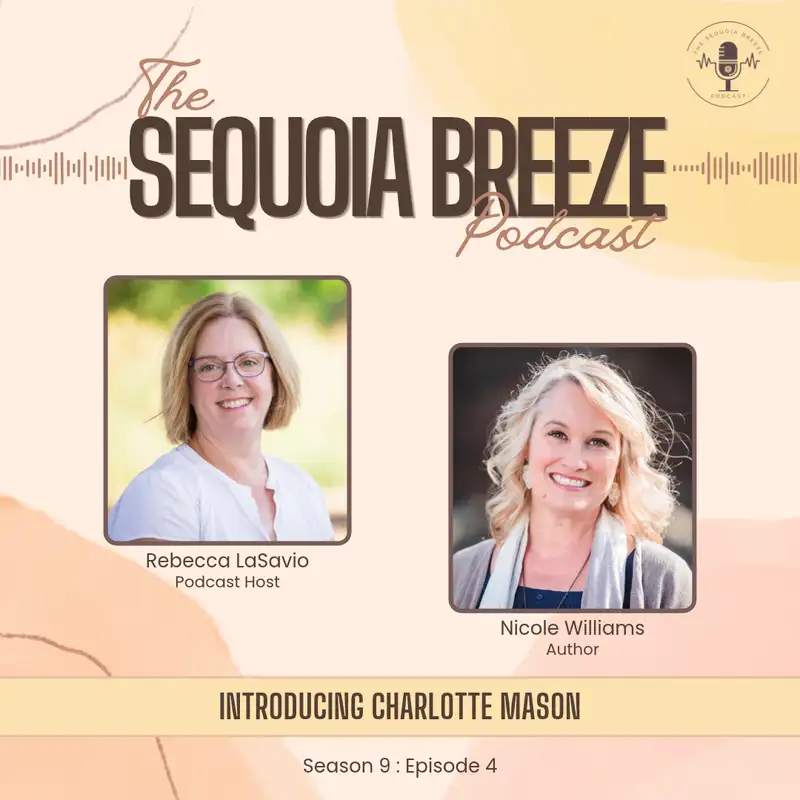
Rebecca: Hello and welcome to the Sequoia Breeze Podcast, a breath of fresh air for your homeschool.
I am your host, Rebecca La Savio.
Thank you for joining me today,
Listeners. For years, I have been wanting to have a series of episodes where we can talk about all of the different homeschool philosophies that are out there that can get a little bit confusing and make you feel overwhelmed when you're getting started.
So I finally found somebody to talk to about the Charlotte Mason style of homeschooling. And so I'm excited to have Nicole Williams here with me today. Thank you for joining me, Nicole.
Absolutely. I'm happy to be here.
So if you would please introduce us a little bit and explain your history and why you're here to talk about Charlotte Mason.
Nicole: Sure.
So I discovered Charlotte Mason.
Good grief. I think maybe it was.
It could have been almost 20 years ago now. I'm thinking of the ages of my children.
My oldest child was in. He was just about to start to third grade, and somebody introduced me to her method and all I heard was nature study.
That was it. I'm like, I like nature study.
Let's do that.
I was, you know,
and then he. That same son just turned 27 a couple days ago. So it's been some time.
But in the course of events, my two youngest children became homeschooling with me as well. So I had three. And then my mom asked me to homeschool three of my siblings, so I had six.
Six.
And then a sister asked me to homeschool one of her kids.
My siblings were all adopted kids who had been adopted at 8, 9, and 10 years old. And I actually have nine adopted siblings. They were the three youngest,
and they had bounced around in foster care for many years.
So they really hated school because when you bounce around in foster care, it means you also bounce around in schools.
So they had that working against them. And then my son was severely. Still is severely dyslexic.
So I had all these kind of odd things that I had to work with when I met Charlotte Mason.
And I sometimes tease that I'm glad that we had some of the problems we had because I might not have adopted her methods. If not,
I might have just, you know, if they could handle the textbooks, if they could handle just doing things in the traditional way, the way I went to school and did school,
I probably would not have really gotten on board with her method like I did.
But I did. And it benefited them so greatly that a couple other ladies and I started a podcast about her method.
So we are working on our 12th season right now,
maybe 11th. I might have that wrong 11th season.
And our whole point was to try to help other people understand what Charlotte Mason even was at the time. There was one website, there was one book,
and.
And then her volumes were printed by one publisher that weren't printing them anymore. So they were expensive.
And it just felt like a real challenge to even learn her method. So that was the point of that. So we began what's called a delectable education.
And.
And then it's just went from there. I have my own website too, where I. I now write science curriculum that's built in Charlotte Mason's with her method and principles.
So I, I've fully adopted what she has to share with us.
Rebecca: I like how you said when I met Charlotte Mason, you're not the first Charlotte Mason method user to talk about her as though you know her.
Nicole: Yes.
Rebecca: Tell us a little bit about who she was, because you haven't met her.
Nicole: Yes, yes, not at all.
So actually she died,
I guess it's been a hundred and six years ago or something like that now.
So she was.
She lived in Victorian England in very early 1900s, late 1800s.
She was something of an orphan later in her teenage years, but became an. An orphan at that point and went to work as a teacher because she needed to support herself, which is,
you know, in that time in history, that was kind of a hard thing.
And while she was teaching, she realized that all the kids that were in her class,
whether they were smart or not smart, whether they had great potential,
they couldn't reach their potential.
They were not skilled in that, in the tools they needed with regard to education to reach their own potential.
And it really hit her hard and made her think about what was missing and what was needed for education.
So. And really, I would say she was quite inspired. She had some ideas about education that were very different than what were then or even now. But she also did read all the philosophers and learned everything that everybody had to say.
But she would, she would pinpoint what was good about that or what wasn't good about that. And eventually she did a series of lectures for a church that was a fundraiser, in fact,
and then was asked to turn those into a book. And so that is how we got the first volume, Home Education.
And that was just her laying out her principles of education and how she thought we should be thinking about kids and even from birth and how we then should be educating them so that we were allowing them to reach their potential,
whether they were, you know, at that time in history, too, there was a lot of, like, this child,
his parent was a mill worker. So there.
That child will have to be a mill worker. There will be no education for that child.
And. And then this other child,
his parent was like a murderer. So, nope, that child, no education for them because he will be a murderer, too. And so there was this whole idea about children in that time.
I don't think we have quite that extent, but I also don't think we have lost it completely.
So she really felt that every child was due a good education and had some real distinct ideas for how to accomplish that.
Rebecca: What was her starting point for. You talked about how we should see children from birth. What was her kind of starting point for that?
Nicole: Yeah, so her idea, this is one of her very first principles, we say, is that a child is born a person.
And so that idea that you are the result of your parents, period, She's. She thought, no, that's not true.
There is potential in all children, for good and bad,
and that if we can raise up the good and help with the use of habits to kind of squash some of the bad,
we can have a child go into a more positive place in life than was possible for them if we just think about them as being a result of their parents or the result of their income.
So, for instance, she went into a town with a school.
It wasn't her doing. It was an educator who took her methods into a town that was all mill workers.
And the children worked as mill workers, too.
And so they set up some school that would happen after work for these, like, early teenagers and on Saturdays,
and they were introducing these kids to things like Shakespeare and history and Plutarch, things that you think, whoa, we're going to start there with these kids. And.
And she felt like that was absolutely appropriate, that we were going to open their minds and. And give them both beauty,
but also something to really grapple with, something to think about.
And so she really felt that from birth we needed to think of these kids as people who were going to grow into whatever their best potential is,
not,
as she explains it, a vessel that we just need to fit. Will, she didn't think that,
you know, we think of school. I'm,
you know, three Rs, reading, writing, arithmetic. We're going to just enter those into our children like a download on a computer, and they will know all the things they need to know.
And she didn't think about education like that. She thought,
let's give them this whole scope of ideas,
of course, in that reading, writing, arithmetic area, but also in all these other areas and see what, see what connects, see what those kids do with it.
And some kids are going to have just affinities with history, say, or music there, just poetry. Some are going to write really well, some are going to be really good at math and thinking through those kinds of things.
But if we give them this broad feast of ideas,
not only well, they have an opportunity to catch hold of the thing that speaks to them best, but all of those other things are going to influence their knowledge of the 1.
My area of interest is science and I'm really fascinated to read the newest research that's coming out that there's schools that you want to be a medical doctor, but you want to get an undergraduate degree that's in history.
Great. We'll have you take a couple of chemistry classes in the summer and will get you into the medical program even though you don't have the quote right.
Undergrad education,
because those doctors then end up being more well rounded and maybe more compassionate.
So we, we do a lot of that in science where we break science into very specific categories and the scientists don't learn about other things and it stunts them, it holds them back from being able to make further advances in their own field because they're just too limited in a specific field.
Rebecca: So Charlotte Mason wrote six books, is that right?
Nicole: Yes.
Well, so we,
we have her five volumes, but we also have geography that she wrote. That was her first venture into book writing was a whole series of geography.
Rebecca: So parents can get to know her by diving into those. Absolutely.
Nicole: But then there's
Rebecca: been a lot of books sort of writing it for today's setting.
Nicole: Yes,
yes, absolutely.
And that's kind of what our podcast, A Delectable Education is about, is trying to help filter through.
We read a lot of quotes on there, so we're trying to,
you know, focus on what she said,
but make it very accessible.
I think we can do it as moms. It's just that we have to start slow. We have to kind of just start, you know, 10 minutes a day reading her volumes and,
and just try to.
Victorian English was a little different.
And there are times where I think, wait, this was early on when I, when I didn't know her method as well, I would think. Now is she being sarcastic or does she mean we should do that?
Took me a little while to understand her enough to know what she was saying.
Rebecca: So I know that there are some sort of guiding principles to her method and what Things are built on. Can you talk a little bit about those?
Nicole: Sure, yeah. So one of the main things, and this is hard for us to understand as we've a lot of us been through a more traditional educational platform, but she didn't feel like we were exactly the teachers.
As parents.
There are certain subjects where we really do have to be the teachers. We still need to do it in a good way. But I'm thinking of subjects like math and grammar that are really one to one,
but as many subjects as possible that we can bring in a better teacher on this subject,
then that's the way to do it. And. And when I say that we're probably all thinking of, oh, yeah, I. I have my kid in an online class or, you know, we go to a co op.
And. But what she meant actually were authors.
So, for instance,
again, I. I write science curriculum, but I really am writing lesson plans. And the real teacher of my science curriculum is the author of many living books. Living books are books that really are capturing the child's attention.
They are written by an author who is passionate about the subject. One example is my high school physics class is written by a man named Walter Lewin, who wrote for the love of physics.
And he was a college professor, but he was an astrophysicist by trade and he loves physics. So he wrote this book to adults, but lay people, not to other physicists.
And he was covering just all the different interesting things about physics. Well, you know, it covers all of the standards perfectly.
And it's written in a way that is so gripping, it's so interesting. He has anecdotes written in there, but even more than that is how he explains the various topics and just get your attention.
That is the main key, is that there is this attention that's grabbed.
So he is the teacher of the class. He is the one we want our kids listening to. Because I try to teach them physics, or if I get a textbook that teaches them physics,
I'm kind of boring them. And we go back to what I said about Charlotte Mason saying they couldn't reach their potential. Well, the reason she said they couldn't do that is because their attention wasn't being captured.
And when we use books like these, these living books, their attention is captured.
History,
citizenship,
all of these topics. We can. We can use living books for these.
Now,
the other part of that is that when they read that living book, that's all well and good, you know, it got my attention. I liked it.
But it doesn't become their own information.
It doesn't become part of them until they do what she calls narration.
And the point of this is that we take in information through one side of our brain and that's just the way it works. There's been lots of studies done on this.
But in order to then tell about that information out loud or to write it down.
And, and I would say this is even akin to when we say you can't teach something.
Or maybe we say the best way to know something is by teaching it.
It's kind of that same thing. To then express the ideas, we have to shift all that information we've taken into the other side of the brain and it crosses the midpoint.
And that is our long term memory storage. That, that midpoint crossing that is where we really secure the information into our brain.
So then we speak it out loud. We, we also in doing that, have to organize that information.
We have to connect it to anything else we know.
We, we just have to maybe filter out stuff that was in the story. But we can't really repeat that whole thing. We've got to just say the main details. So we're filtering through some things.
There's a lot happening there. Which again is what we do when we teach, right? We take in all sorts of things and then we filter it down to what is important, do we think, and we give it to the kid or the person we're teaching.
The problem with the teaching though and us doing that for our kids is that Charlotte Mason said it was pre digested.
And if we let them grapple with the material themselves,
then do that narration,
they are making it their own and they are picking out parts that stuck with them or they relate to more or maybe they have some background so one child's narration won't sound exactly like another child's narration.
So reading those living books, thinking of those books as the teacher and then asking that child to narrate back, that really is the child doing the work.
So where are we?
You know, we have, we have no part in this, it seems like, but we do. We actually do in part because we're coming alongside of our child. We're encouraging them, we are putting that feast of knowledge out in front of them.
Most kids are probably not going to want to learn about.
I think we, we cover something like 10 subjects a day in a Charlotte Mason education. We have short lessons and we cover a lot of things.
So it's very different from maybe an unschooling method.
The mother does have to keep that schedule going, keep that child moving through the Next subject. And the next subject. And that's our role is really to come alongside of them,
keep them accountable, put that feast in front of them,
and then ask for the bits we need. Like, we need the narration. We need to give exams to the kids so that they. That's another narration, by the way, where they are telling what they know about things.
So it's very different, really, from the traditional style education.
One of her main principles is that feast that I mentioned, that there are like 10 subjects a day,
which seems overwhelming to us moms, but the kids just take it readily.
And having all of those different subjects that we're quickly moving through in a day just keeps it all fresh and exciting. And the child who's super interested in math is like, yes, we're on to math.
And the child who isn't super interested in math is like, okay, math's only gonna take 30 minutes period,
you know,
moving on.
Rebecca: Well,
so for those who just kind of went, ah, I'm not interested in this, because when they heard 10 subjects, you're talking for a lot of them,
like 10 to 20 minutes, right?
Nicole: Exactly, exactly. And some of them are odd little things like 10 minutes of working on recitation in a day. And what she means by that is how to read. Well, so they're working with a story or a poem,
and they're not memorizing it. Exactly. Lots of them will memorize it, but they're learning, where's the punctuation in this? It's like public speaking for what we would call it these days.
Where's the punctuation?
How am I going to inflect my voice?
There's. Some of. It is just. There's rules to this stuff, and some of it is a bit of an art,
and.
And we get 10 minutes to do this. But that 10 minutes every day,
all the way through school really adds up to something really great.
Rebecca: When I was investigating this topic a little bit and trying to get to know who you were a little bit, I listened to that podcast a few times,
and I caught the episodes that talked about art and music.
And it. It was 20 minutes a week for each of those things. And I thought,
I can get 20 minutes a week.
Nicole: Yeah. And
Rebecca: I can easily see the way it was being described, how by the end of the year,
you and your kids have learned a lot. Even if you don't know anything about art or classical music, you could learn a lot in 20 minutes a week if you kept it
Nicole: up. Yes.
And it's a progression too, because you begin so let's take art for an example. And music is exactly the same.
Just this 20 minutes,
we're looking at a piece of art. We're trying to commit the picture to memory,
look back at it again, commit it to memory.
Eventually, we're turning that piece of paper that has the print on it over so they can't see it. And we're asking them,
okay, tell me what you saw in the picture.
And if there's multiple kids, all the better, because they can all go around. I've actually done this with a class of adult parents.
I think there were 45 people in the class,
and everybody had something to tell me. You know, what color was bedspread, what color, you know, what was on the wall, what, what was going, what direction was the sun coming from, all these little details.
So they've committed it to memory, which, by the way, that visualization is enormously valuable in education.
We want our children to be able to look at the letter B and D and be able to really notice the difference between them.
We're kind of working on that when we're doing this art study.
So there's a lot of overlap of things.
We're reading a little bit about this artist over the course of that semester or that term of study.
Over that semester, we're.
We're looking at about six different pictures from this one artist.
And what happens is then that student kind of learns that skill, style, and they come to know that artist a little bit themselves.
Obviously, we have to be particular because some artists have backgrounds and lifestyles. We don't want to tell them all the things about, but we can tell them enough, you know, where they lived and things like that.
I remember the first time one of my sisters walked into a bed and breakfast. My dad and her were traveling, and she said there was a.
I don't know what it was, so some painting on the wall. And she could recognize the artist because of his style,
and it was really exciting to her, so she really come to know him. But then as they get older, they actually read a book with art history.
And now they know all the artists because they've been doing this for years.
But they're going to read this book of art history, and it's going to tie all the pieces together and look at the big movements of art and why they happened and work through it.
Well, then in high school, we can give a credit that is towards art history,
and that's usually just a half of a credit, usually.
But we have done this work to really lay this foundation of art history.
Same thing with music. And then so it's music appreciation, it's art appreciation. It's not the same thing as playing an instrument. That would be a separate thing.
But it's a really great addition to their education,
and it's a great addition to our week. Who, when we are only doing the math and the reading and the history,
and we throw in something like this. It's really delightful.
Rebecca: You've alluded to it, but I know one of her principles is attention.
Nicole: Yes.
Rebecca: Can you talk a little bit more specifically about that?
Nicole: Yes.
Rebecca: Narration is one of them. Attention is another.
Nicole: Yes. And really the narration is part of that idea of attention. So I mentioned that we use these really great books. We don't just use any books to.
So that we're capturing that attention.
And sometimes,
you know, that that looks different for each subject there. You know, history can be really fascinating if told by somebody who really is a great writer. Right. They could have the same information, two different people, but one of them is going to be a great writer who's going to draw us in.
So that's part of that, that attention.
And then in order to narrate, we have to have exercised that attention because we're not going to have anything to say otherwise.
And she does say that that will happen once in a while, and we just kind of have to,
you know, shrug and tell the kids, oh, that's just too bad. You missed that, you know, and that helps them later to build up that attention. I also mentioned these, you know, 10 lessons a day,
okay. But 10 minutes, 20 minutes. Some things are as much as 30 minutes. But then what we find is later on in high school,
their. Their science lessons are 40 minutes long.
Well, that's really nothing compared to a regular,
like the block system in a regular school these days.
But we have taken them from that 10 minutes of full,
steady attention,
Reading the book,
narrating it back,
really strong attention.
Now we're working all the way up until they can do that for 40 minutes.
They can have sustained attention for that long. There is not an adult I know right now who can have sustained attention for 40 minutes.
It's just our culture has been working the other direction, not this direction.
So that attention is huge. And it's. It's what she said made the difference in an education.
Think about it like a child cannot learn if they do not have the ability to attend to the subject for any length of time.
And that also leads into habits.
Yes,
yes.
Of which attention is one of them, actually.
So she talks about multiple layers of habits and some of the important ones that we start very young. You know, there's a lot of what she talks about in her volumes and I, I said five, I, there are six volumes plus the geography.
Early on, she talks a lot about parenting and laying some of these habits and they help us in school.
You know, if we have children who are obedient,
who get up and push in their chair,
who respond with kindness,
these kinds of habits are going to help us in school. But she also talks about intellectual habits which we don't think about.
This is things like attention. It's also things like imagination.
Wow. We do not think about building imagination as a habit.
But I, you know, I was just talking to my daughter in law the other day and she is an engineer.
And there's a type of engineer that is called an imagination engineer or engineer of imagination.
And it has to do with like city planning or something where they have to think it through. And I said, but aren't all engineers very imaginative? And it took her back for a second.
And I said,
everything you're dealing with,
at least for a time,
is in your imagination. You have to imagine how your circuits are going to work,
how this building is going to stand before you ever even test those things out.
So imagination is very valuable in many fields of study. Think about the human body.
Most of the time it's imagination the doctor's using so that he can understand what's happening inside that is not even visible.
So there's many factors in the curriculum where she's asking for imagination,
like I mentioned, the visualization,
that piece of things. Well, often they're asked later to maybe paint something from memory.
When we talked about that picture study,
I said that they do six for a single term, but a term lasts longer than that. And the other weeks they're asked to draw a portion, not the whole painting that they've studied, but a portion of it so that visualization and imagination really work together.
And those are just some of the habits, you know, neat work, perfect execution,
things that think about the character building factors that go into this that later on our students not just have good manners,
but they have the ability to just deal with the world on a habitual basis. One of the things she talks about is having a,
a pleasant disposition as a habit.
Yes, I would like all of my kids to have that.
So she has a list of them in her, in her volumes. But they are very foundational,
not just to being a person, but also to having the ability to be well educated.
Rebecca: So Habit. The. These building these habits is to her part of the education. It's as important as learning math.
Nicole: Absolutely.
Rebecca: Because it's educating the whole person
Nicole: and
Rebecca: giving them character to tackle the difficult math problems. Is
Nicole: that a fair. Absolutely.
I would say that's absolutely true. And one of the first things people hear about Charlotte Mason with regard to math is that if they work through this problem and they get it wrong, that you don't have them go back and fix that problem.
You give them another similar problem and you talk to them about where things went wrong,
but they get another chance to try it.
That's really contrary to what we usually do. We want. We think about,
well, let's go back and figure out where it went wrong.
Well, the truth is,
they know the parts.
Hopefully we're not trying to teach them.
Well, let me put that a different way. Hopefully we're not trying to test them through the math problem. We're giving them. Hopefully we have really taught them the foundations they need in order to do that math problem.
And what we really need from them is to work with very careful precision each one of the steps on its way through there.
And if we are careful to not give them a problem that they can't do,
it might be hard, they might have to take their time, but they can do this. They have the skills. And then we ask them to do that. Well,
if they don't do it properly and we have to give them another problem,
we are teaching them that habit of perfect execution that we need to take our time and do this carefully.
So those habits are just built into much of her methodology.
It's not that we need to sit and teach our kids habits so that we can then start school. It's really built into all of it.
Rebecca: So if you have an older child and this is the first time you're hearing about Charlotte Mason and it's intriguing you and you're interested,
Nicole: is
Rebecca: it possible
Nicole: to jump in?
I think so, for sure. And this is what I did with my siblings. My siblings were in 6th, 7th and 8th grade when I started to homeschool them this way.
And as I said, they.
They actually.
They're a funny story. I always use the example of the two on the. The youngest and the oldest of them that the oldest was failing every class when in school.
When he started homeschooling with me and my dad said his theory was, you can't eat him,
I was like, you just literally could not force him to learn anymore. He was not going to accept that.
And the youngest one,
she was getting all A's in everything.
And when I got the two of them side by side, I realized, you know, the older one who was failing all of his classes,
probably.
He was probably smarter than her. There was a lot of gaps in her understanding.
But that youngest one had really learned how to work the system.
And now I was asking the two of them to do the work of their education by themselves. But I was also inspiring them with really good books. And it was so fun to see them come out of their shells.
For my. My youngest sister to really start thinking through things on her own, not just thinking about what I wanted, what answer I wanted out of this. But. But what did you learn from this?
What did you take away from this? And then my brother, on the other hand,
I remember the first time he opened a book from the library on his own, not because I had assigned him a chapter of it,
but because he was interested, because he was sort of coming to life with regard to education.
So, of course, they are kind of an extreme case because of their background,
But I think that all of us,
I mean, even us parents are somewhat in the same place as them, because a lot of us have had this same style of education, this pouring in of an education,
and then this testing.
Did you get out of this what I wanted you to get out of this?
You did. You have an A?
You didn't then you don't. I don't care what you think or. Or where. Where your ideas, you know, what you gathered from this.
I want you to know what I think you should know.
And the reality is, typically they learn what needs to be known. You know, we do have standards we've gotta work with across the board,
but they also learn so much more, and it becomes their own learning.
So one of Charlotte Mason's main ideas was that they would come to love learning through this method, through their education. And that education was not a finite thing. It wasn't like you graduated from high school and that's going to be the end for you or college or what.
And then at that point, education is over. You're an educated person at this point.
She said no. Education was either something we're always doing or we're not being educated. It's like our. A whole lifelong thing.
And so I think that it is important to start utilizing these principles for the sake of an older child, because we want them to continue learning on into their adulthood and be interested in things.
One of my favorite things is talking to my dad about the books that we're reading. And it's it's fun. We, so we want that for our kids, not for them just to shut down and shut off and just go do your job now later on in life.
Rebecca: I have recently met multiple sort of sixth, seventh graders who are coming out of public school because the system is not serving them well. And I think what you're talking about with your brother and sister is, can be true for them.
Even if it's not that they're coming from a dysfunctional place. It's that school has stunted their ability to learn because they're just being told they're behind.
Um, their confidence is shot. They're,
they think they aren't any good at this school thing.
Nicole: Right.
Rebecca: And I've been trying to encourage their moms like this first year out,
yes, you're going to do, you're going to learn and work on math and those things. But this, kiddo, is your project. Like,
Nicole: yes.
Rebecca: Building the confidence. And that's what I'm hearing you say through this way of doing things is that they're using their brains. They're explaining to you what they're learning. They're practicing doing it well.
And it's,
that's going to be a confidence builder.
Nicole: Absolutely.
Yeah.
You know, the way I explained with that math that we teach them,
you know, I'm thinking about say like a seventh grade level math. We've taught them to add,
subtract, divide, multiply.
They know something about fractions.
And then we're asking them to do maybe a more complicated problem that has a few steps in it.
We haven't, we have taught them, we better have taught them all of those previous steps so that they are comfortable in each of those and then they can take their time and work through that problem.
They have opportunity to be successful then.
And every problem they do after that, we do the same kind of thing. Let me teach you a step.
And then have a problem that you can be successful in.
And of course they're going to continue to increase in their abilities this way, but they're also going to have great confidence that they can work through a problem and they can get there, even if it takes time.
It's, it's really a cool thing. You know, I used to think,
oh, when, if you have, in a scenario like you described,
maybe you should just take some time off. Like just let everybody decompress.
And now I think now more than that,
give them something great to work with and ask them what they think about it. Ask them,
you know, I, one of my kids was in an upper level history book and one was in a lower level.
They're both reading about the same time in history. Like, I think it was the New Deal at the time.
And my youngest daughter was narrating from her book. And this was such a, a great thing and so compassionate and so wonderful for society. And then my son comes walking in from the other room and is like,
no, this has problems. And, and he'd been reading something else completely different and, and he was narrating back with his ideas.
And they were both right. You know, they both had something to add to this, even though neither one of them are going to check a on the multiple choice.
And, you know, that was the right answer.
And that is what our life is really about.
Most of the problems we have in our society are complicated. They do not have the perfect right and wrong answer for all people.
And when we start treating our kids like that, that there is a right and wrong for everything they read about or learn about in school. School, we're not really teaching them to think.
And,
and the point of this is that when we're asking them to think, we're caring about them as a person, for one thing. But we're also teaching them how to deal with the world at large when they get,
you know, to have to vote or make decisions for their own family later on.
Right. I don't think we're doing them any service by making them think that there is a right and wrong answer to everything.
Rebecca: You hinted at this a little bit with your son's dyslexia, but does a Charlotte Mason method work if you have kiddos with special needs?
Nicole: Yes, I think that's such a great question.
And you've heard me talk about these books. The book is the teacher and all this stuff. And that can be very overwhelming when you think, wait, my kid doesn't read, like there's a problem,
or I, you know, talked about math and maybe they have dyscalcia.
Here's the thing that I have found. So I have, I have. My son was severely dyslexic. Still is. He's 27 years old now.
And I have a daughter, my second child, who I would say is lightly dyslexic. She's probably pretty seriously dyslexic, but compared to my son, it was nothing.
What I learned with my son is that two things. One is children who have special needs often have superpowers that are completely above and beyond what us normal people have.
They can see things in the world in a different way.
So we shouldn't be making them feel like they are less than because they aren't learning just the way that we like as a culture learn things.
Also.
There is so much to learn that if we hand, if we hold them back to where their difficulty lies. Like with my son, if I held him back because he needed the special reading classes in a regular traditional school classroom, he would be in special ed classes.
He would have been in them all the way through school.
He would have missed a whole lot of learning because the focus would have had to been on this, this one thing that he wasn't good at.
Instead,
he learned copious amounts of history and science and citizenship and just all of the subject geography.
And he,
he learned it all so well. He narrated it all so well over all those years, very often orally with me writing dictation for him as I needed to,
that now in his adult life,
he not only sounds very intelligent, but he is very intelligent.
And when a person thinks finds out that he's dyslexic, severely so it's kind of a shock to them.
He has also learned how to work around those things and you know, write the reports he needs to write, fill out the forms he needs to fill out.
So we never stopped reading lessons with him all the way through school,
but we also never held back the rest of the feast of learning that he could engage in. And, and we have so many more tools now to deal with that.
Think about all the audiobooks that are available to us when there isn't an audiobook for something.
We have apps like there, there's an app called Seeing AI which will read a page of text for you.
It's actually made for people who are either visually disabled or reading disabled and it's free on everybody's phone and it works spectacularly. I have a friend, well, my co host on the Delectable Education who is blind and uses it to read whole books on the regular.
So we have some tools that we can work with but at the same time we need to remember that that one disability, that one difficulty that our child has is not their whole identity.
So let's teach them all the things that we can outside of that and just tap into, like I said, that superpower that they have.
Rebecca: Is there anybody that you think this philosophy would not work for?
Nicole: I,
I would say not. I'm just. I, well, okay,
it is not a plug and go curriculum.
It, there is some work that it's going to take on the part of the mom.
There are some sort of box style curriculums that do utilize this method.
There are some people who do consulting, my co hosts do consulting where they try to help put together a plan for you, but it is still not where your kid gets up and turns on the computer and does their schoolwork and is done.
And so if you're not willing to put in the time that it would take to implement this kind of a curriculum, I will say that the school day for your youngest child should be no more than two and a half hours using this plan.
And even in high school it shouldn't be more than four hours.
So we are moving through those, those subjects quickly and getting a lot done in a day. But we don't want them to be,
you know, having a six or seven hour long school day.
But still, if you're maybe working from home, I do know some people who work from home or even work out of the home and implement this kind of a curriculum.
But it's, I think it's pretty hard if you're not going to,
you know, put in the work that you need to do to facilitate it.
So yeah, that would probably be the one, the one thing I would check
Rebecca: before. Oh,
this hops back a little bit to what we were talking about earlier. But I did want to touch on the fact that Charlotte Mason methods are fantastic for family based learning, for family style learning where you're doing multiple things together.
Nicole: Yeah.
Rebecca: And I think you've alluded to that. But I did want to point out because there are a lot of new homeschoolers out there who are still discovering the wonder of history for everybody, science for everybody.
Nicole: Yes, yes.
Rebecca: Have to be separate for every single kid.
Nicole: Do you elaborate on that? Yes. There's a lot of places that we can do overlapping things. There are places that we can't.
You know, obviously we've talked about math. A student has to just continue through their pace in math and it's something I see with homeschoolers all too often is that they are not letting that older student proceed forward as is necessary.
And they're kind of being,
if not held back by the younger student,
they're at least not being encouraged to move forward and get going on things. So,
but that said, still within math, we can do like drill games where we're asking a question and we're, we're aiming one at the younger student that's at their level and one at the older student that's at their level.
Again, that takes a little bit of preparation.
But we can work together on things like that. That mental math,
we can do math games together. We can read math books that are about, like, the history of math or.
Or let's read through how. I'm thinking of this book, String, Straight Edge and Shadow, that was about geometry. That's kind of interesting. So there's things we can do together,
and there's things that we do need to do separately.
All of that, art and music, that can all be done together.
There's things that overlap.
So your elementary students and your middle school students might be in the same place in history and even using the same book,
where your high schooler might be in the same place in history,
but they're using a different book. So we can kind of all communicate about those things. It's one of the things that I do love about the. The method and overlapping in that way is that it.
It allows kids to converse about the things they're learning,
to play out the things they're learning in afternoon, you know, free time, play time. They're outside, you know,
redoing the Battle of Hastings or something like that, you know,
and that is really fun. It makes for a fun culture in our homes if everybody's in the same place. Now, not all Charlotte Mason curriculums are set up that way,
but that is how Charlotte Mason did it, where she did have everybody reading about the same history and at the same time bringing in those artist studies, those music studies that were in that same period as well.
So it really created a culture.
Makes a lot of fun for field trips and museum trips too, if everybody is studying that, that same stuff.
Rebecca: So before I ask you where parents should start, if they're interested in this, I do want to cover one thing, and that is that I know that there are a lot of curriculum or websites that are focused on Charlotte Mason that are religiously based.
Can Charlotte Mason be done second secularly?
Nicole: Yes, absolutely. And the reason I say that is because there is curriculum out there that is religious based.
And it's. It doesn't need to be.
It's not in a subject. It's like math programs that have a Bible verse at the top of the page. It's math.
It doesn't need to be religiously based.
If you are somebody who is a believer that's going to filter through your whole life without somebody putting a Bible verse at the top of the math page.
But because of that, somebody who is not religious should be able to use all the material without needing that.
So, for instance, in my science curriculum,
I have a few of my guides where there is a reference to typically what it is is the difference between maybe a Young Earth or an Old Earth belief.
And that's something that Christians deal with as well as everybody else.
But those little things can be just removed. And so I have a whole secular line that has each one of those little things. You know, maybe there's, maybe there's one, maybe there's three little instances of those and I've just removed those.
But think about like reading a book for history, you know, early American history.
There's no need for there to be anything in there that is religious based. If you have that belief in your home, you're going to talk about that, but it doesn't need to be part of the curriculum if, if that's not your foundation.
So where would you send parents to get started to delve in a little bit deeper? Yes, I think that the best place is my podcast with my co hosts and a Delectable Education that's@adelectableeducation.com but it's available on any podcast app.
But I would go back to the beginning and listen to the first 10 episodes of that podcast because that really talks about the foundation,
what it is she was trying to accomplish, how, how she sees the children. Some of the things that we've talked about today and then I'm particularly fond of our most recent season season are and we're recording our next season now, so there'll be two years worth starting now.
But we've got one full year out where we have gone through every subject one by one and talked about how it's done.
What's the point of it? What does it look like through all of the years of study.
What you do with your elementary kid is one episode. Then what you do with your high schooler is a different episode. So there's some filtering through there based on the age of your children that you can do.
We have like a preliminary episode that talks about the subject as a whole and then you can pick the level that is most applicable to you and your kids.
So that's where I would start. I we really worked very hard to be very clear about what Charlotte Mason taught.
I mentioned that when I started there was so little out there. But since then in the last 10 years we have gained thousands and thousands of pages of what's called the Parents Review, which was and sort of like a magazine but old fashioned style that Charlotte Mason edited that was teaching about her method.
We've got that we've got over a decade of programs that were the assigned work that she assigned students semester by Semester. And we've been able to pull, pull out of there and see,
oh, this is how it progresses over the years. Here's where she's going to with this. You know, we're starting with this. What seems kind of silly. One thing I would say about Charlotte Mason's education is that it seems like it starts slow.
And when your kids are really little, you think, oh,
is this enough? Are we doing enough? But what she's really doing is laying a really strong foundation because she expects them to go far and above where the traditional schooling would go by high school.
Rebecca: So it's a trust the process.
Nicole: It really is, yes.
Rebecca: And
Nicole: tell us where
Rebecca: your
Nicole: science
Rebecca: can be found because I'm pretty sure you're a vendor with our schools.
Nicole: Oh, yes, I am. I am at Sabbath Mood Homeschool,
that is dot com.
That name is based on a Wendell Wendell Berry poem where he talks about us doing the work in the day,
but that we have to then, just like you said, trust the process.
We go to sleep at night and that seed's gonna grow or not grow,
but we can't make it grow.
But we still have to do our part. And so that's where that name come from. But I have science curriculum there for students of all ages. And then I also back to my roots of what brought me to Charlotte Mason in the first place.
I have a nature study curriculum there as well.
Rebecca: I will put links to all the stuff that we're talking about in the show notes listeners, so you can find that.
But a lot of Charlotte Mason doesn't have to be a purchase curriculum.
Nicole: Right?
And really, I would even go so far as to say that you do not need to dive all the way in 100% right from the get go.
You might listen to the episodes we have on history, for example, and start out out with your history curriculum and little by little, maybe pull in some artists and then pull in some music and then learn about how she did math and pull that in and just start adding to it.
I. I think it's. I think it's excellent when people can jump in,
you know,
both feet, go for it.
But I'm not really that kind of person myself. I don't have maybe as much energy as the moms who can do that.
And so for me,
starting a little bit at a time, you know, next month, adding another thing, reading about it, learning about it, adding the next thing.
I think that if you add a subject and I think history would be an excellent place to start because you'll see the benefits of that pretty, pretty quickly, and it's easy to pull in other parts of it.
I just think that you'll see how the method works and then do all your other things.
But she said if you were going to do. Because schools picked up her method later on, and she wrote to them and said, if you're going to do a single subject, that's fine.
Just do it exactly how I tell you to do it.
And so.
So that might be something to think about. Like, really learn about how this was done. Do it. Do it well.
And it'll be short because even the longest history lesson is still just 30 minutes.
And do it well and see how it goes. I think you'll be impressed
Rebecca: if you only do half of her method and you can't say it doesn't work.
Nicole: Yes, yes. Well, is there anything else that you think parents should know before we sign off today? Well, I guess just a bit of an.
Rebecca: Mountains of it. Just. Oh,
Nicole: yes,
yes, I have. Like I said, like, I don't know, we're on 11th or 12th season. I've talked about this quite a bit in my life, so I have a lot to say.
But I think mostly just to encourage you. As homeschool moms,
we don't often have something to compare our kids to, so we.
We feel a little bit lost. Like, are they doing great? Are they doing poorly?
And often what we revert to is we see the problems. They're not adults yet, and so we see, well, their behavior is not really that great yet. And.
And they. They will just will not learn their multiplication tables. Like, we've been working on it for two years,
and we forget how long it took us to learn these things. We just. We don't have that reference point.
And. And so we.
We dwell on what's not happening or what's not there yet.
And, And I would just encourage you.
We need to just do our best by our kids and continue to pull them forward day by day, a little bit at a time.
And we will be so surprised by how far they get at the end of these 12 years of education that we have to offer them or. Or if it's four years, if we're starting later.
But that daily work, that daily progress forward is going at their level, you know, always,
always stretching them,
but always stopping to where they actually can accomplish this thing that we're asking of them.
We're going to create a great education for our kids and do really well by them.
And as I mentioned, My son is 27 now. My two girls are 21 and 23 and my siblings that I homeschooled are even older than them.
And I look at them and I think they are people that I like.
I like them. I like being around them. They are interesting. They are doing hard work and these are the people that we're raising the. And you know,
it's so worth it. What you're doing is so worth it. You're just,
you're giving so much to them and it will pay off in their lives.
Thank you so
Rebecca: much, Nicole, for sharing your wisdom and your knowledge and your experience with us. I appreciate it.
Nicole: Absolutely.
Rebecca: Listeners, thank you for joining me today on this episode of the Sequoia Breeze Podcast. I hope it's been a breath of fresh air for your homeschool. I've been your host, Rebecca La Savio, and as always, I would love to hear from you.
You can find all our episodes at sequoiabreeze.com you can also get a hold of me there by just pushing the orange button and leaving me a message. I'd love to hear your ideas, your thoughts, ways that using Charlotte Mason has worked for you,
things that you've seen just bring your kiddos education alive.
Thank you for being here today, everyone. I look forward to seeing you next month when we are going to talk about unschooling.